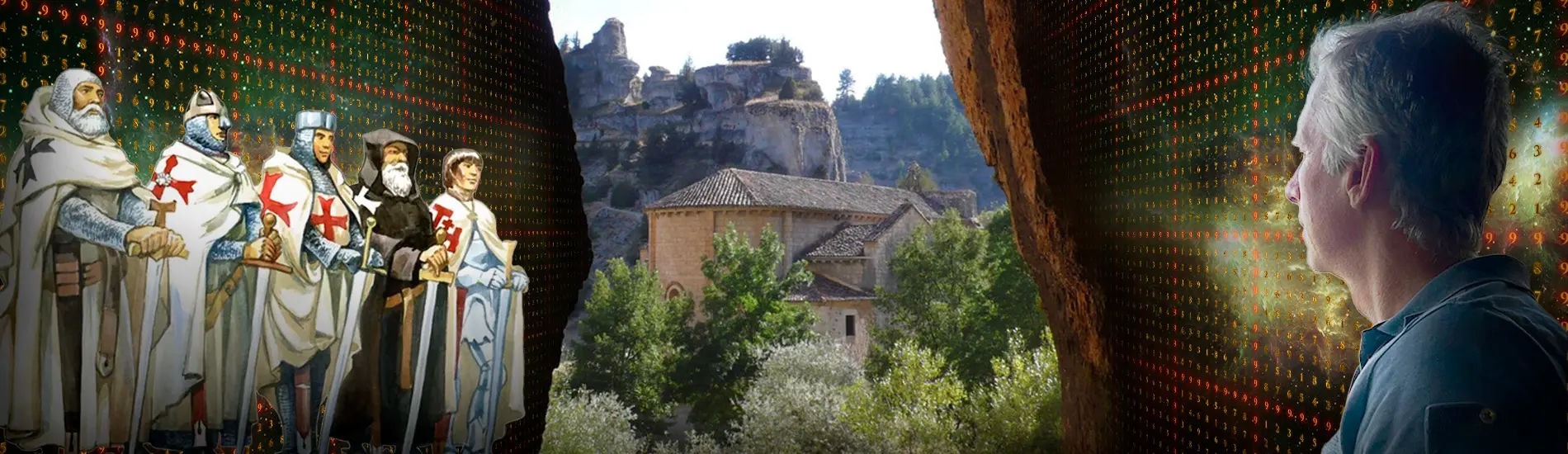
Notes on the Secret of the Hermitage
Hermitage of San Bartolomé at Río Lobos, Soria, Spain.
Before beginning, I would like to thank the valuable contributions of several people whose research has helped me greatly in preparing these historical notes: Juan García Atienza, Alejandro Aylagas, Alvaro Rendón, Angel Almazán, Gonzalo Arenas, Rafael Fuster, Jordi Aguadell, and Carlos Sánchez-Montaña.
This work is an excerpt from the historical notes of the novel Pandora’s Verses.
Willy M. Olsen organizes an initiation into this mystery. The details can be consulted at this link.
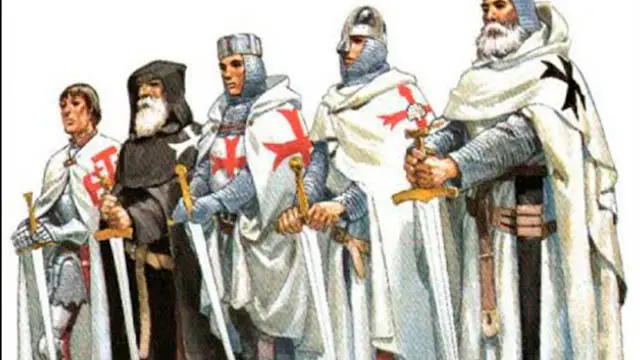
Talk on the Templars and the Río Lobos hermitage by Willy M. Olsen.
1. Historical Background.
The hermitage remains intact for nine centuries.
Today, many certain and historically verified facts are still unknown regarding the construction of the Hermitage of San Bartolomé and the village of Ucero, where a large Templar castle stands. Historians estimate its construction between the late 12th century and the early 13th century. Archaeologists confirm that the caves in the canyon were inhabited in prehistoric times, as some remains attest. The area attracted neither Romans, Visigoths, Moors, nor Christians. It remained basically abandoned, even during the repopulation of the Osma region in the 12th century. Not until 1157 does the first mention of Ucero appear.
The documents of the Order of the Temple mention the existence of the Monastery of San Juan de Otero among its various possessions and commanderies in Soria, and note that it was widely known because its monks were initiated there in transcendental knowledge. However, no record provides details about its exact location or its characteristics. Its relevance must have been well recognized, since in 1170 Pope Alexander III mentions the Monastery of San Juan de Otero in a papal bull.
After the annihilation of the Order of the Temple through the papal bull of Clement IV in 1310, Templar possessions passed into the hands of the Church or the king. In this case, the Monastery of San Juan de Otero became part of the inventory of the bishopric of Osma. The discreet and remote hermitage ceased to spark interest without the Templars’ patronage. Its name was changed to the Abbey of San Bartolomé. The abbey lacked regular office or ministry, apart from sporadic visits by certain figures. In subsequent centuries it was the object of some territorial disputes with little consequence. From the year 1800 onward, the abbot in charge showed so little interest in the place that he delegated its care to a caretaker. The Napoleonic invasion, which caused great destruction in the village of Ucero, paid little attention to this remote hermitage, which survived the French unscathed, as well as later reforms. The 19th-century disentailment ended its abbey status, leaving the hermitage without Church resources. The parish priest of Ucero, together with the faithful of the region, then took charge of maintaining the hermitage—preserving the exterior intact and adapting the interior to their convenience. They bricked up some windows and accesses, re-paved the floor, replaced the stone roof with tiles, and built an annexed sacristy, as it stands today. Around 1870, the Romanesque Virgin of Health was replaced by a new one. The old one was too small, black in color, and badly deteriorated. On August 13, 1931, the Provincial Commission of Monuments considered the hermitage a national artistic treasure, which helped it emerge unscathed from the Spanish Civil War and the harsh transition that followed. In 1985, the surrounding area was listed as a natural park.
What is astonishing about this brief chronology is that the hermitage has survived intact through nine centuries of upheavals—except for the 19th-century works described. Today we have the opportunity to look, almost directly, through this window into the past and to try to tune into the elaborate “ars memoriae” that its builders took pains to bequeath to us. Despite its simplicity, certain atypical elements stand out in this 12th-century construction: its location, its orientation, its structure, its decoration, its original name, and the 112 corbels that border its rooflines.

2. Location.
A site that geologically writes the Name of God.
In 1979, the researcher Juan García Atienza published a book, The Secret Goal of the Templars, in which he recorded a series of suggestive geographic coincidences. The hermitage was equidistant from Spain’s most extreme enclaves: Cape Finisterre in Galicia to the west, and Cape Creus in Girona to the east. The estimated distance from the hermitage to both places was 527.127 km.
Using the hermitage as the center of a great Templar cross, with its arms opening 40° and separated by 50° from each other, the edges of that cross intersected with the most relevant Templar or esoteric enclaves of the Iberian Peninsula, such as Toledo, Caravaca, Culla, Palma de Mallorca, Fátima, and Tomar, among others.
The later precision provided by GPS navigation refuted this supposed equidistance, which incurred a minimal inaccuracy of between 4 and 5 km. However, if we are to be so scientifically exact, we should consider that Finisterre is not Spain’s westernmost point, but Cape Touriñán. Applying GIS measurement again, the results show a difference of 49 meters! On one side 532.793 and on the other 532.744, which expressed in Roman miles (1,480 m/km) yields a result of 360 Roman miles on each side. A perfectly round number!
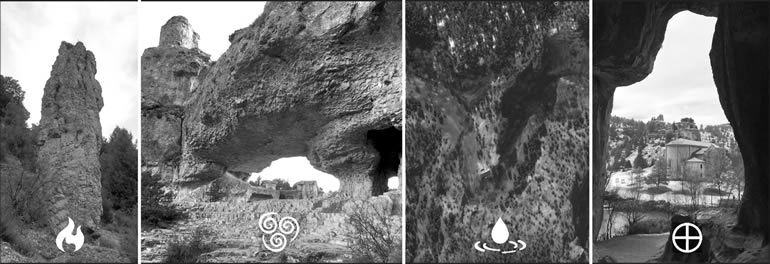
In my opinion, such a coincidence can only be due to the great sensitivity and intuition of its builders, or to the fact that this precise location fits within the arc that would be traced by connecting four natural elements that geologically portray the Name of God in this peculiar enclave. Let us recall that the Hebrew letters YHVH symbolize: hand, window, nail, and window.
Less than one hundred meters south of where the hermitage is located, a natural monolith rises about eight meters high which, according to archaeologists, was an object of worship since primitive times. This monolith could be interpreted as the index finger of the hand of God pointing toward what we want (Y). The hermitage is located exactly between two rock “windows”: one looking toward the sky just west of its position (H), and another to the east, formed by the entrance to the cave that leads into the interior of the earth (H). The hermitage itself forms the tip of a rocky atoll, like a great limestone nail (V), as can be clearly perceived from an aerial viewpoint.
However, the geological transcription of the Name of God in this special location could be formulated in an even more literal way, consistent with the graphic form of the letters. The monolith, the only one in the area for many kilometers, can clearly indicate the letter “Y”. The stone windows fit an “H”, as it was written in the 12th century. And the “V”… for this letter one only needs to look at the sharp bend the Río Lobos makes between the cave entrance and the hermitage’s location.
3. Ucero.
The earth’s matrix, and Saint John as the marker of the solstices.
“Otero” could refer to the hill on which the Templar commandery that protected the hermitage was located. Otero means an isolated hill dominating a plain, which fits well with the castle’s placement—an edifice without strategic, military, commercial relevance, nor even as a place of passage. I find no other reason that would justify building such a stockade in the village of Ucero, other than the surveillance and protection of the modest hermitage located a few kilometers away. The name Otero would highlight that function in this case. However, there is also another unsettling similarity that etymologically fits very well with Ucero: “Utero” (womb), whose Indo-European root is “Udero”. The cave facing the hermitage, with an entrance resembling a vagina, could hardly have a better name than the place where the miracle of life’s creation is conceived.
The hermitage’s orientation is not exactly east to west, as corresponds to the major axis of any Christian temple. It is deviated 23.5 degrees to the north. The height of its arrow slits and stone rosettes is carefully calculated so that in October sunlight falls upon a subtly marked path on the paved floor. As the days pass, the sunlight traces an “S”-shaped route along the floor until it reaches a unique and specially decorated slab located before the chapel of the Virgin of Health (VS), situated to the north. The sunlight’s path culminates on this slab precisely at the winter solstice, after which it begins to trace its way back out. The location of this slab is designed so that during both equinoxes the sunlight strikes it momentarily. The study of the astronomical alignments by Rafael Fuster and Jordi Aguadell can provide many more details about this fascinating phenomenon. The sunrays that trace this “S” enter through the stone rosette during the winter solstice and through the southeast arrow slit at the equinoxes—both converging on the slab of the Virgin of Health. Forming a V!
4. A hermitage designed to invoke the Name of God.
Structure and decoration aligned with the Name of God and the numeric matrix.
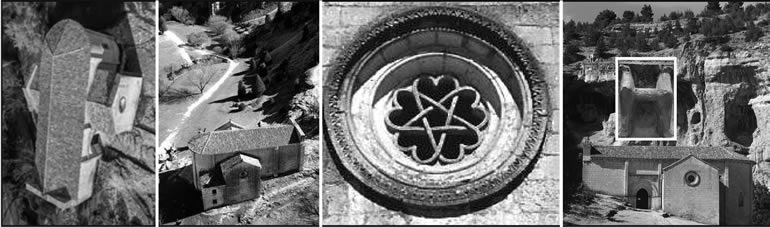
There are several atypical and special elements that often go unnoticed due to the apparent architectural simplicity of the Hermitage of San Bartolomé. One of them is the slab of the Virgin of Health, whose studied position—tuned to the equinoxes and the winter solstice—we have already mentioned. Another element is the absence of the customary lantern tower. The transept nave, lower than the main nave, sits below the impost lines of the vault. This architectural arrangement relates to the two rosettes, which frame an inverted five-pointed cross and which, in my opinion, was conceived to highlight the letters of the Name of God, YHVH.
The Y would be projected by the line that connects, inside the main nave, the apse arrow slits with the narrow window in the west that served as the original access door and is currently bricked up. The H would be traced by the walls of the lateral naves, connected transversely through their two rosettes. The V is emphasized in those rosettes, which draw attention because they present the inverted five-pointed cross. The final H is perfectly drawn in the hermitage entrance. It is also doubly emphasized by a corbel, right at its center, in position number five of the line of corbels that draws the transverse line of this architectural H. This corbel not only carves an H, but if we look closely, a vulva and the tip of a glans emerge below it. What better way to represent the power of creation! YHVH!
In this discreet way, the structure elaborates the Name of God and its functioning. The main nave (Y) conjures the invoker’s intentions; the transversal nave (H) gives them their first form; the (V), doubly signified by the rosettes and by the astronomical alignment, concentrates the power of creation; and the final (H) gives final form to the manifestation of the invoker’s intentions. This means that what we consider the main entrance would have constituted the exit when the hermitage was used for the invocatory purposes for which it was designed.
The geometric motifs decorating the capitals of the 8 interior columns constantly emphasize two elements: alternating diamonds, and volutes perched upon dotted lines. The ribs that illuminate the main entrance are ornamented with two opposing four-petaled flowers, with a dot in the center. A precise way of representing the numeric matrix described in this book. The diamonds are a simple way to symbolize 4+4 with more dynamism than squares. The volutes on dotted lines will be discussed later, together with the corbels, because they are an essential element of the vocabulary of invocation.
The four interior capitals at the entrance also present—besides the geometric motifs described—other highly significant symbols. On the capital to the north there is a bearded head representing a Templar; the Cross of the Temple is also carved on that capital, in case there were doubts. On the other three capitals there are heads without beards: one emphasizes the ears, another the eyes, and another the mouth. The beard, besides being prescribed by the Rule of the Temple, symbolized wisdom. This combination could well mean the following: whoever learns to listen, to see, and to pronounce will attain wisdom!
The ashlars of the hermitage are full of pictographic marks. Many correspond to traditional stonemasons’ marks. Master masons would mark, with symbols characteristic of their authorship, the stones they had cut and placed. In this way, the foreman reviewing the work could count how each mason’s work had progressed and pay them accordingly. However, there are other interesting marks that are more elaborate than those used by the master masons, and whose meaning is not clear.
5. The Message of the Corbels.
An interpretation of the 112 corbels that surround the hermitage.
The interpretation proposed below is based on the premise that the builder of the hermitage had knowledge of the structure of the numeric matrix, and of its implication in the Kabbalistic principles underlying the Name of God.
The geometric motifs that decorate the hermitage reflect the numeric relations of the matrix, and the key of nine in its multiple combinations. The relevance of the tetraktys can be deduced from the ordered reduction of the total 112 corbels bordering the hermitage: 1, 1+1, 1+2, and 1+1+2—that is, 1, 2, 3, and 4. The tetraktys, and the 4, symbolize the four letters and the structure of the Name of God.
The hermitage was conceived as a place for invoking the power of the Name of God. The corbels attest to this function and provide instructions on the keys to achieve it—like a mnemonic reference engraved in stone—while also transcribing a protection spell over the integrity of the place and its use. To enter this interpretation, we must first clarify the elementary words of its vocabulary.
The corbels’ vocabulary:
Rectangle = Name of God.
The empty corbels with a rectangle—engraved or raised—refer to the four letters of the Name of God. In relief they manifest its power; engraved they attract, or invoke, the Name of God.
Empty = Will.
Completely empty corbels denote pure potentiality or, in other words, the divine will.
Barrels = Works.
The barrels shown on several corbels refer to the inner work the adept must undertake to reach their aims.
Volutes = Results.
The volutes that appear—both on some corbels and on the interior capitals—indicate the evolution, or result, of the invoker’s work. Volutes shown alone refer to the complete invocation. Volutes also appear split into groups of three: two at the same height and one in the middle, but lower. In this case they indicate that, to reach the result, balance is necessary. This balance, depending on the context, may come from heaven (Father, Son, and Holy Spirit) or from the invoker (mind, heart, and will). The mind and emotions must be balanced at the same height so that the will is channeled through their exact midpoint, without deviating to one side or the other.
Plants = Manifestation.
Another recurring motif—both on the corbels and on the interior capitals—is vegetation, primarily in the form of leaves. Plants symbolize manifestation—what germinates as a result of invocation.
Vertical line = Energy.
A vertical dotted line represents the manifestation of the invoked energy. I want to emphasize that the experience of perceiving this energy is physical, similar to what can be felt with an orgasm. It is not an imaginative device. This energy is often felt as pulses or waves, which fits its dotted representation. In a few cases, the energy line is continuous, indicating that its direction is not ascending, but descending.
Heads = Subject.
Some corbels present heads with the crown flattened and covered, on which concentric circles are drawn. These heads receive the divine—whether wisdom or power, or both—depending on what the figure conveys. Rounded heads do not denote connection and refer to the subject according to each context.
Once the fundamental meanings of this stone vocabulary are established, I will proceed to describe the interpretation of each corbel segment. The corbels are read from left to right. One begins by interpreting all the corbels on the main nave, corresponding to the process of invocation. Those on the transversal nave serve another purpose: complement and protection.

THE HERMITAGE’S HIDDEN MESSAGE
OPENING
1. Opening Invocation. 8 corbels.
“IN THE NAME OF GOD. May Your will be done yesterday, today, and always, as in Heaven so on Earth. I, the invoker, request the opening of these works. Guide me to hear the word and do Your will. May it be so that these works are closed.”
- 1.1. Corbel with a raised rectangle manifests the Name of God.
- 1.2. Empty. Totality. May Your will be done. Past.
- 1.3. Empty. Totality. May Your will be done. Present.
- 1.4. Empty. Totality. May Your will be done. Future.
- 1.5. As above and below. As in Heaven so on Earth.
- 1.6. Three separated barrels. Opening of the works.
- 1.7. I, the invoker. Give me ears to hear the word.
- 1.8. Inverse of the three barrels. May the work be closed in this way.

INITIATION
2. Requirements of the Work. 6 corbels (Above the portal)
“Let wisdom come to me. I have honored the purity of my bonds, I strive to pronounce Your name with my whole being, I have mastered my emotions, I have calmed my mind, and I have ears to hear. May Your will be done.”
- 2.1. Head with a flat cap and concentric circles. Divine wisdom.
- 2.2. Two naked men embracing. Pure bonds, without hidden motives.
- 2.3. Flutist with penis (severed). Sounding with body, mind, and emotions.
- 2.4. Mocking face. The expression of emotions.
- 2.5. Serene, well-presented face. Mental serenity. Attentive listening.
- 2.6. Empty. Totality. May Your will be done.
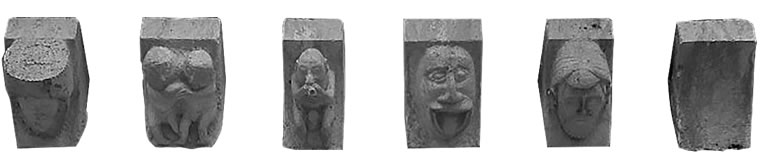
3. The Invocation. 10 corbels, ordered according to the tetraktys. (Portal)
“I begin the work by unifying the three levels. I pronounce Your name and assume responsibility. My will manifests in creation with all its power. The Name of God has been pronounced, the ritual has been properly conjured, my will has been heard, and the manifestation has become reality through the Name.”
- 3.1. Beginning the work by unifying the three levels: mind, heart, and will. (1)
- 3.2. Barrel with 9 sections, on the head. I pronounce Your name. (2)
- 3.3. My intention is firm, and I have assumed the weight of my invocation. (2)
- 3.4. Face connected to the divine (flat crown). My will. (3)
- 3.5. H with vulva and glans. The manifestation of creation. (3)
- 3.6. Powerful animal. With all its power. (3)
- 3.7. Deployed tetraktys shows a barrel. Name pronounced, unveiled. (4)
- 3.8. Four synchronized heads. The ritual has been properly conjured. (4)
- 3.9. Elevated head, almost identical to 3.4. My will has been heard. (4)
- 3.10. Corbel folded in the middle. Your will folds to my will. (4)

4. Development of the Work. 13 corbels (5+4+4)
“May Your will be done as in Heaven so on Earth, for the Name of God has been pronounced. Bless me so that my will may be Your will; bless my strength and my intention so that they do not falter; bless the reach of this work so that it arrives where it must arrive; and bless my vision so that I may be an instrument of Your purpose.”
- 4.1. Two rolls above and below. Like 1.5. As in Heaven so on Earth.
- 4.2. Empty. May Your will be done in Heaven.
- 4.3. Empty. May Your will be done on Earth.
- 4.4. Perimeter mark. The Name of God.
- 4.5. Concentric perimeters. Labyrinth. Name pronounced, or unveiled.
The ridge of the transversal nave separates the first stanza from the second set of corbels. This second stanza of 8 is read from its midpoint outward, following the indication provided by the first corbel in this series (4.1.). The first four are identical, and signify that the blessing and power of the Name of God fall upon each of the following.
- 4.6.7.8.9. Perimeter mark. The Name of God.
- 4.10. Face over emptiness. May my will be Your will.
- 4.11. Wolf or lynx. The strength and alert attention of the wolf or the feline.
- 4.12. Octopus. The reach of the four tentacles, or four elements.
- 4.13. Insect head at the top. Vision of the beyond and purpose.
The insect, in this case a bee, is very appropriate as the culmination of initiation for several reasons. The bee, or the initiate, works as a team, contributes to the purpose of the hive, can fly autonomously through the sky, has good vision and a sense of orientation. In addition, the bee was the emblem of the Merovingians; for the Egyptians it represented the power of monarchy, produced honey, stung its enemies, and was associated with the soul. In short, it symbolizes work well done through industriousness and obedience.

ADVANCED WORK
The following three corbel series were designed exclusively for masters and correspond to a different work than the initiation work described. For this reason, these corbels were placed in the curved area of the apse, where the abbot or master of the ceremony stood. The opening invocation is also valid for this work. In this case, we begin again, since this development is not an initiation but the start of an advanced level, unfolded in three parts: invocation, warnings, and results; and finally culminating with the fourth series, the development, described on the north wing of the hermitage.
5. Invocation of the Advanced Work. 6 corbels (Apse – South)
“May this work occur only if it is Your will. May my will be Your will. Raise me to the beyond. Grant me perspective and power over political and religious matters. Give me wisdom about what I do not know. Watch over my physical body as well as my dream body during this work.”
- 5.1. Empty. The will of God.
- 5.2. Face over emptiness. May my will be Your will.
- 5.3. Circle atop a rectangle. Raise me to the beyond.
- 5.4. Square over Chrismon. Power over political and religious matters.
- 5.5. Owl with large eyes. Wisdom about what is unknown.
- 5.6. Watch over my physical body as well as my dream body.
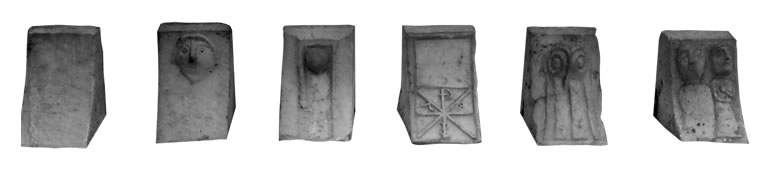
6. Warnings of the Advanced Work. 6 corbels (Apse – East)
“This is an advanced work. It must be performed at the right moment. When conjuring this invocation, fear may devour you, you may lose your life, great serenity is required. You run the risk of being possessed by the will of evil.”
- 6.1. Advanced work. Indicated by double the barrels compared to the initiation.
- 6.2. Conjunctions and alignments. It must be done at the right moment.
- 6.3. A fierce wolf framed. Fear may devour you in the invocation.
- 6.4. A framed body that does not procreate and does not speak. You may lose your life.
- 6.5. A serene framed face. Great serenity is required to invoke.
- 6.6. Smiling demon. You run the risk of being possessed by the will of evil.
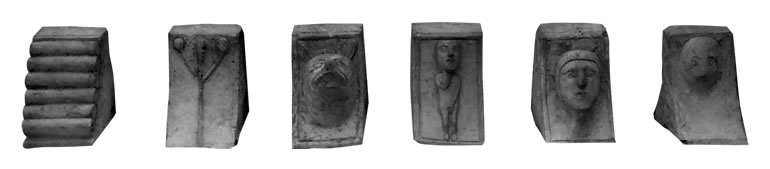
7. Results of the Advanced Work. 6 corbels (Apse – North)
“Heaven and Earth attend to You, my will. You will manifest a body to visit the heavens. The will of God blesses you. You will obtain vision and understanding of things, and you will anticipate the future. You will bend events to your will. The power of Heaven is channeled in you.”
- 7.1. Corbel folded top to bottom. You, my will be in Heaven and on Earth.
- 7.2. Bird. Autonomous dream body, similar to the Egyptian Ak.
- 7.3. Empty. Blessing of the will of God.
- 7.4. Face and torso leaning forward. Vision of things, and perspective on the future.
- 7.5. Double keel. You will bend events to your will.
- 7.6. Eight-pointed star with a continuous vertical line descending.

Next comes the longest series, with a total of 22 corbels, corresponding to the development of the advanced work, just as its parallel segment on the south side corresponded to the development of the initiation work. Since the first three corbels show an evolution from one, to two, to three, and the last twelve are empty, these 22 corbels could be identified with the Hebrew letters, divided into the three mother letters, seven doubles, and twelve simples. The Hebrew letters represent the 22 paths of the Kabbalistic Tree of Life, connecting the 10 sephirot. However, there is no evidence that Kabbalah was so deeply introduced in this period, nor is any allusion to it highlighted in this construction.
This series is divided, just like its southern counterpart, by the ridge of the northern transversal nave, which breaks the sequence between corbel 9 and 10. In addition, it is relevant to note that the slab of the Virgin of Health, indicating the confluence of the solstice and the equinoxes, is located precisely on the interior of the wall on that north side, and at that position. This slab is a rosette with 10 petals, which reinforces the importance of corbel number 10 and the subsequent division of the sequence.
The slab of the Virgin of Health combines a pattée cross with a six-petaled flower, symbolizing the two tablets of God’s law, which divided the commandments into the four of invocation, which would open the ear of heaven, and the six precepts of integrity, which would elevate the voice of the invoker.
The first corbel of this series continues the motif that ends the last corbel of its southern homologous series: an insect head, a bee, which in the south culminates by giving the initiate vision of the beyond and granting them a direct connection to divine purpose. In this case, the development of the advanced work begins where the initiation had culminated.
The second part of the sequence corresponds to 12 empty corbels, inviting the invoker to receive the blessing of the twelve apostles of Jesus, or else to traverse the zodiac cycle, to commune with the forces of each sign and how they interact with creation. The journey through the zodiac signs was an ancestral ritual that summoned the power of heaven, as indicated by corbel 7.6. This secret transit completes the process of evolution of the advanced invoker.
8. Development of the Advanced Work. 22 corbels (9+1+12) (Apse – North)
“Nourish my presence in Heaven. Transform me, fill me with strength, vision, and power. May my will manifest in Heaven and on Earth. The power of the Name: Father, Son, and Holy Spirit, I pronounce it from my ancestral essence, and I manifest it in creation. In the name of God, I traverse the heavens according to Your will.”
- 8.1. Insect head (bee) sipping nectar. Nourish my presence in Heaven.
- 8.2. Large insect head sipping. Strength, vision, and connection. Queen bee.
- 8.3. Trident keel. May my will manifest in Heaven and on Earth.
- 8.4. Destroyed corbel, unidentifiable.
- 8.5.6.7. Perimeter frame. The Name of God x 3: Father, Son, and Holy Spirit.
- 8.8. Naked head whistling. Ancestral man, unadorned, sings the Name.
- 8.9. Oval belly. The creative power of number 9, the essence of the Name.
- 8.10. Perimeter frame. The Name of God.
- 8.11 to 8.22. Twelve empty corbels. Journey through the twelve zodiac signs.
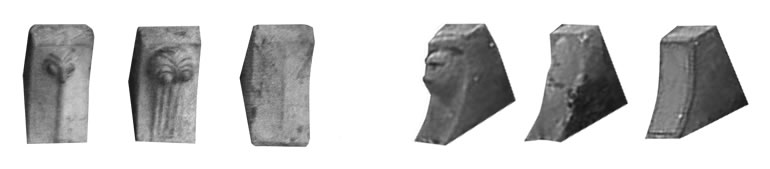
CORBELS OF THE TRANSVERSAL NAVES
Purpose. 6 corbels (Southwest transversal eave, next to the Portal)
“Here we invoke power. Whoever firmly fixes mind and emotion, and centers their will, may obtain this power and manifest it in a great diversity of forms. There are two modalities to invoke the Name of God in this temple: one person alone for the advanced ritual (to the north), or an initiation ritual with four people (to the south). The paths of manifestation of this power are unknowable and unpredictable.”
- 9.1. Three volutes over dotted lines. Invocation of power.
- 9.2. Three volutes with nothing. We fix mind, emotions, and will.
- 9.3. Three volutes wrapped in leaves. To wrap oneself and manifest power.
- 9.4. Clovers. Manifestation of power in diverse forms and modes.
- 9.5. Cross, with person, cross, and two rectangles. Ritual modalities.
- 9.6. Three little spheres and geometric lattice. Repercussions of manifestation.
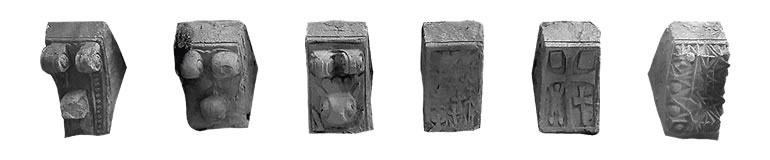
10. Warning. 7 corbels (Southeast transversal eave)
“Templars! We know you. We know of your desire to obtain power to dominate the world. Come here as an obedient lamb; watch that hidden desires do not impose themselves upon your will. You aspire to reach celestial power. The weight of responsibility will fall upon the initiate. Such is the will of God.”
- 10.1. Templar head with helmet and beard. Like the entrance capital.
- 10.2. Two men with flat heads embracing, or dominating, the world.
- 10.3. Lamb. Obedience and submission.
- 10.4. The will of the animal, or of desire.
- 10.5. Name of God. Celestial power. Ten-point star (3. Initiation).
- 10.6. Let the weight of responsibility fall for pronouncing the Name in vain.
- 10.7. Empty. The will of God.
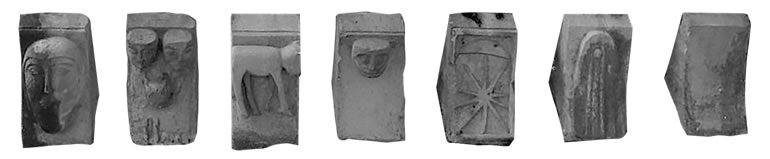
11. Custody of Power. 6 corbels (Northeast transversal eave)
“Here we invoke and manifest power. Nothing escapes its reach. Nothing escapes our knowledge. We know how to pronounce the Name and unfold all its power. Circumstances do not matter. We are its custodians. We are at the service of its protection and wisdom.”
- 11.1. Volute over a dotted line, surrounded by clovers. Invocation of power.
- 11.2. Stem and branches with dotted line. The reach of power.
- 11.3. Large bird eyes at the top. We watch from the beyond.
- 11.4. Four vertical dotted lines. We invoke the power of the Name.
- 11.5. Shape with hollows and protrusions. Circumstances.
- 11.6. Turtle head at the top. Protection and wisdom.
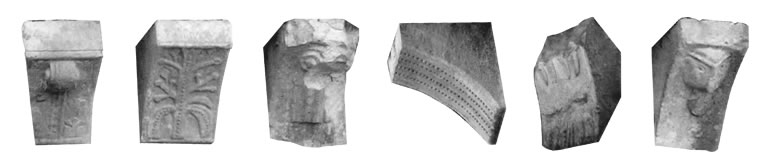
12. Protection Spell of the Place. 7 corbels (Northwest transversal eave)
“God! May Your will be done yesterday, today, and always. No matter what circumstances or people may come, by Your will may this place remain protected. So be it.”
- 12.1.2.3. Empty. By the will of God. Yesterday, today, and always.
- 12.4. Shape with hollows and protrusions. The circumstances that may come.
- 12.5. Empty. May it be Your will.
- 12.6. Watchful animal with prominent chest. The protector.
- 12.5. Empty. May Your will be done. So be it.

CLOSING
13. Closing of the Invocation. 8 corbels.
“These works are closed, as God commands.”
This strip begins with the corbel that is the inverse of the three barrels, indicating the closing of the work, followed by 7 empty corbels. These three closing barrels are located in the same position as their opening counterpart on the south side, keeping the works indicated by the corbel sequence always closed unless their opening is invoked. There is another important detail to highlight. The last corbel, the one that closes the series, rests or fits into the end wall, whereas its opening counterpart—the first, which represents the manifestation of God in relief—is free from touching any wall. Nothing blocks it. The western wall of the hermitage was built slightly offset so that this last corbel would press against it, leaving the first corbel free. The seven empty corbels of the closing series allude to the manifestation of the will of God over creation. Genesis describes how God created the world in six days, and how on the seventh He rested, just like this last corbel.
Work concluded!