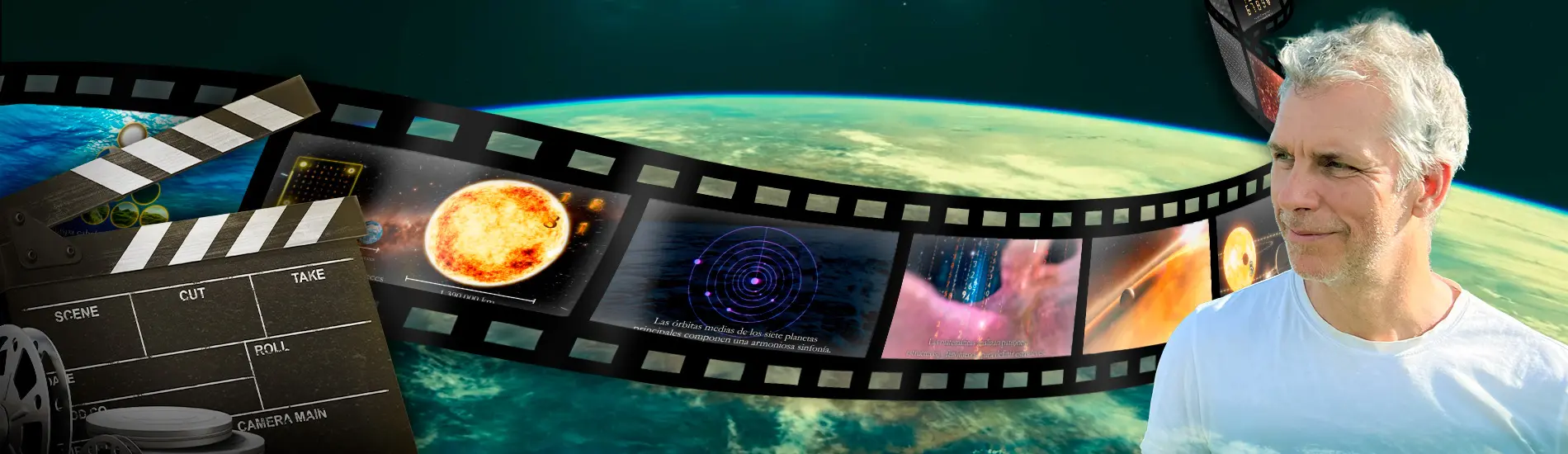
Part 6/7 of the Documentary: The Language of Numbers.

The Harmony of the Spheres
Part 6/7 of the Documentary: The Language of Numbers.
Today, modern science is beginning to confirm what Pythagoras could only imagine: the Solar System is tuned with musical precision — the harmony of the spheres.
Venus and Earth trace a PHI pentagram every 8 years. Jupiter and Saturn orbit in a 5:2 rhythm that stabilizes the Solar System. Uranus, Neptune, and Pluto move together in a 1:2:3 cadence. The dance of their orbits weaves sacred geometries with a precision impossible to ignore.
Planetary distances follow hidden patterns. Their synodic cycles reveal pentagrams, five-pointed stars, perfect hexagrams, and proportions resonating with Phi, Pi, and the matrix of the Name of God.
It is undoubtedly a work of cosmic engineering designed to build a planetary starship carrying life — and us — through a hostile universe.
I invite you to listen to this silent music and tune yourself to the beauty and awe gifted to us by this miracle.
Documentary produced for educational purposes and on a non-profit basis by WMO Productions.
- These productions are funded by Willy M. Olsen in order to share this knowledge.
- If you would like to contribute and appear in the credits of future productions, please consider making a donation.
- If you enjoyed this documentary and want to help, please share it and spread the word.
- If you want to stay up to date with the latest productions and courses and initiatory work, write to me through the website contact form and I will email you with updates.
All music and images are used exclusively for educational, outreach, and non-profit purposes within the context of a scientific explanation of this documentary’s purpose. This content is protected under the Fair Use principle according to Section 107 of the Copyright Act of 1976. Non-commercial use further supports fair use. There is no intention to infringe copyright. All music and visual content belong to their respective owners. If rights holders consider the use inappropriate, please contact us so the corresponding material can be reviewed, modified, or removed.
- Direction, Production and Script: Willy M. Olsen
- Filmmaking: Laura Romero Alcobendas
Full Script – The Harmony of the Spheres
The Solar System operates through gravitational resonance of musical harmony.
The history of our world would not have been possible without this harmony.
The Solar System is distributed into four rocky planets and four gas giants separated by an asteroid belt, composing a spatial pentagram (1/2, 2/3, 3/4, 4/4, 1/8, 2/5…) that, among other things, follows the Titius–Bode Law. Named after its discoverers in 1766 (Johann Daniel Titius & Johann Elert Bode), this curious law establishes a peculiar distribution of planetary distances from the Sun. To this day, no definitive explanation exists for why it works.
We begin by doubling numbers starting from 3:
0, 3, 6, 12, 24, 48, 96, 192.
Then we add a full measure of 4 — like a whole musical note:
4, 7, 10, 16, 28, 52, 100, 196.
Dividing by 10 converts the sequence into percentages. In this way, Earth becomes the reference point (1), and the other percentages approximate planetary distances from the Sun with over 95% accuracy.
But the harmonies extend far beyond this.
A synod is the conjunction of two planets at the same degree of the ecliptic — how they connect within the same orbital circle.
Venus and Earth align every 13 Venusian years and 8 Earth years (13/8 ≈ 1.6 PHI). Their synodic cycles trace a five-pointed star every 8 years. The pentagram is the geometric symbol of PHI — the pattern of beauty. Since ancient times, Venus has been considered the goddess of beauty.
All planets dance interwoven. Their synods generate sacred geometries both collectively and individually.
Mercury follows a 2:3 orbital resonance — every two orbits, it rotates exactly three times. Mercury also “kisses” Earth 22 times in 7 years (22/7 ≈ 3.14 PI). The mean orbits of Mercury and Venus relate through three tangent circles whose centers lie along Mercury’s orbit with 99% precision.
Venus rotates extremely slowly and in the opposite direction of most planets. A Venusian day lasts 243 Earth days — exactly 2/3 of Earth’s orbital year. Given the 13/8 resonance with Earth, the harmonic relationship between their synods and day lengths causes them to face each other with the same orientation at each point of the pentagram.
Earth fine-tunes its distance from the Sun, its size, its rotation speed, its tilt, its orbit, and the influence of its unique satellite to sustain LIFE.
Mars synchronizes with Venus to align with Earth three times for every four alignments of Venus. The relationship between the perigee and apogee of Mars and Venus mirrors the size ratio of Earth and Moon: 11/3 — or 27%.
Jupiter has four large moons — Io, Europa, Ganymede, and Callisto — which emulate the Solar System on a smaller scale. The first three orbit in a 1:2:4 resonance: one orbit of Ganymede equals two of Europa and four of Io.
Jupiter shares its orbit with two clouds of asteroids called the Trojans, positioned 60° ahead of and behind the giant planet. Connecting their positions traces a perfect hexagram. Inserting successive hexagrams within this geometry defines a circle whose interior closely marks Earth’s mean orbit with 99.8% precision.
Saturn and Jupiter orbit in a 5:2 gravitational resonance: Jupiter completes exactly five revolutions around the Sun for every two of Saturn. This resonance prevents Jupiter from falling inward toward the Sun.
The orbital ratio of Saturn and Jupiter is 11/6 — 0.5454545454… — precisely double the Earth–Moon size ratio of 11/3 — 0.2727272727…
Uranus, Neptune, and Pluto follow rhythmic orbital relations of 1:2:3. Pluto’s year corresponds to two Neptune years and three Uranus years.
And there is more.
For example, the diameter of Neptune’s orbit equals the circumference of Saturn’s orbit. Likewise, the diameter of Saturn’s orbit matches the circumference of Mars’ orbit.
But perhaps the most beautiful insight is this:
The mean orbits of the seven principal planets compose a harmonious symphony. Our Solar System is not a static disk. It is a spacecraft transporting us through the galaxy — surfing stellar currents, navigating plasma clouds of the Milky Way, bathing in energies emanating from its center. Not too close to suffer its intensity. Not too far to be exposed to external dangers.
And at what distance?
At a Phi proportion from the center of the Milky Way. (50,000 light years / 30,000 light years ≈ 1.6)
There is little left to say.
Only to recognize that the Solar System is a design created to safeguard a treasure:
Our world — Earth.
And you are on it.
So… what will your footprint be?