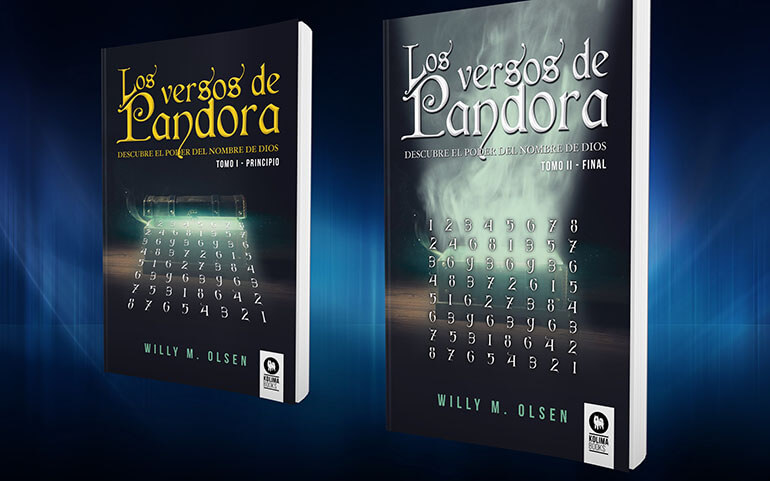
Discover the Power of the Name of God
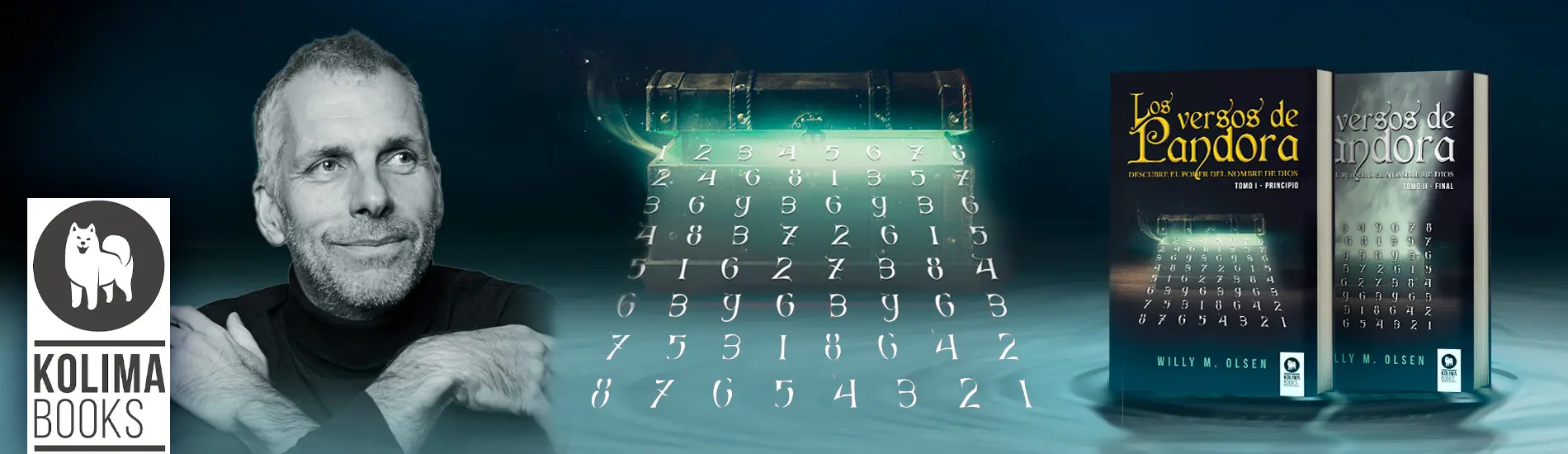
Pandora’s Verses offers a different perspective on relevant historical events whose legacy we have inherited. It weaves an entertaining plot while also exploring the inner workings of a numerical matrix that, according to the author, underlies the structure of reality.
This novel does not chase a mystery that ends up burned, buried, sunk or destroyed at the last moment without revealing anything. The core of the narrative is to enter the mystery—fully—even if that requires following the long journey it demands.
The author, Willy M. Olsen, worked on the development of Pandora’s Verses for more than ten years. Yet it is not only the result of academic training or exhaustive documentation, but also a consequence of extensive experience and years devoted to self-knowledge.
Pandora’s Verses is far more than a novel—it is a journey, a true initiation.
Pandora’s Verses
Discover the Power of the Name of God
Click to order this novel from Editorial Kolima, or on Amazon.
A Historical Novel, an Initiatory Adventure…
Pandora’s Verses proposes an initiatory journey through history to better understand the world of today. It forms an intricate mosaic integrating the reconquest of Hispania, the Almoravid invasion, Viking settlements in the Mediterranean, the expansion of Islam, the rise of Christianity, the First Crusade, the mystery of the Templars, and the origins of Kabbalah—offering an integrated perspective on 15 centuries of events, treated with both narrative enjoyment and historical rigor.
Using the 12th century as its historical frame, the novel unfolds a powerful mystery—often mentioned, but rarely explained in detail. It has been called luck, the law of attraction, “the secret”… yet at its core it concerns invoking the power of the Name of God: a power to which the Bible repeatedly alludes, presented here as real and tangible. The Name of God is not simple to “pronounce.” The characters of this novel show how they achieved it—and how it enabled a seemingly impossible mission: to close Pandora’s box, while also laying foundations for Kabbalah, influencing the origins of the Templars, and many other adventures that shaped the world we recognize today.
An Unprecedented Discovery
Pandora’s Verses revolves around one mystery: the power of the Name of God. This discovery is presented as real and original. It was coveted by Roman emperors and medieval kings; it shaped the thought of figures as diverse as Laozi, Ramses, Pythagoras, Confucius, Zoroaster, the Buddha, and Moses. Each “pronounced” the Name in a different way—through a power that does not rely on words, but is transcribed through numbers—and which the characters of Pandora’s Verses learn to traverse.
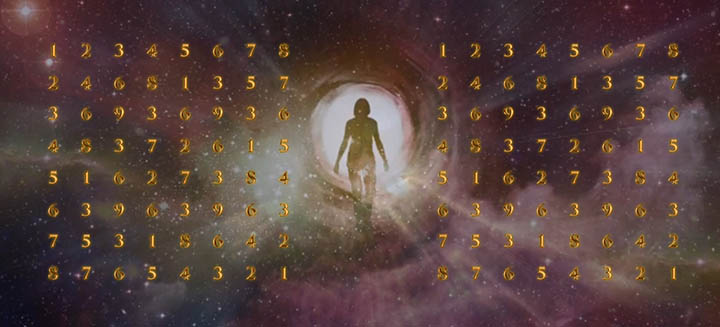
Why are numbers written the way they are? Digits can be read as lines of energy. Their interactions form a language of creation. The harmony of numbers is structured in a matrix that gives shape to its grammar and semantics. Arithmetic alone is insufficient to grasp these laws in full; human language is limited—perhaps poetry offers a closer approach. Pandora’s Verses attempts exactly that. This matrix is the common denominator of the Kabbalistic reduction of all numbers into infinity. This matrix forms the Name of God. Reality is built from it. This novel reveals how.
Mysteries Revealed
Why was the Dome of the Rock built? What does the peculiar mosaic of the first Christian church in Israel represent? What are the true foundations of Kabbalah? What truly inspired the First Crusade? Why were the Templars founded by nine knights for nine years—no more and no less? What is the meaning of the corbels at the Hermitage of San Bartolomé in Soria, Spain? These are some of the revelations presented in Pandora’s Verses, grounded in historical rigor.
What was Zoroaster’s true mission? Why did Laozi write the Tao Te Ching? What was Confucius trying to resolve? What prompted the Upanishads to be written down? How did Persian and Egyptian magic function? What was Pythagoras’s dramatic failure? Why did the Buddha decide to share his wisdom? And what is the common denominator between these figures of the 6th century BC and the protagonists of Pandora’s Verses in the 12th century? The answer, according to the author, lies in a numerical matrix from which their systems of thought can be deduced. These numbers are the Name of God.
The Characters of “Pandora’s Verses”
The characters of Pandora’s Verses teach mastery of the mind, emotions, dreams and the body, and connect the reader to the foundations of our culture.
Each character’s inner evolution strengthens capacities that allow them to unravel a mystery history had seemingly buried: the power of the Name of God. A Tuareg, a Christian, a Jewish woman, and a privileged concubine define the contours of this power—presented as real and effective, as the Bible suggests. Driven by the greed of the leaders of their time, who seek to dominate this power, the protagonists become immersed in an unprecedented mission: to close Pandora’s box. The consequences of that mission still resonate today.
TAREQ – MASTERY OF THE MIND
Tareq is one of the characters in Pandora’s Verses, a Bedouin from a declining family in North Africa. Through Tareq, the story explores the expansion of Islam and the impact of the religion of Allah on Bedouins who survived harsh desert lives or guided caravans. Yet what Tareq ultimately reveals is not merely resilience, but how he refined mind and intuition to near infallibility—and how inner integrity opens a path through the impossible. Tareq is the air that gives life to this story.
MASTERY OF THE MIND: The mind is untamed. It resists yielding control to the consciousness within us. It overwhelms us with carousels of thought and disperses focus with remarkable precision. Why? Not because the mind is malicious. It performs its function—like a ship captain who refuses to hand control to the owner because he does not trust the owner to steer. Inner impeccability and awareness of death are two pillars that can unify the chaotic concert of the internal dialogue. Only then, the Name of God can be “pronounced.”
RODRIGO – MASTERY OF EMOTION
Rodrigo is one of the characters in Pandora’s Verses, a Christian rejected by his family who finds destiny through the Camino de Santiago. Rodrigo reveals the contradictions and illusions that shaped the kingdoms of Castile and Aragon in the 12th century. Old Hispania was a complex mosaic of cultures and religions, struggling as intensely to coexist as to separate. Rodrigo faces his own inner conflict. To resolve it, he must dive into the unconscious and learn its workings—gaining an unusual form of power. Rodrigo moves through the emotional world like a fish in water.
MASTERY OF EMOTION: Emotion is energy in motion. Emotions are the words through which the unconscious communicates—with us and with the rest of the universe. The rules of that hidden world are not the same as everyday psychology suggests. In the unconscious, time does not exist, but hierarchies do; language is symbolic, cryptic, and personalized to each of us. We have tools to dive inward, uncover the true memory, reprogram its influence, and regain freedom of being. When we stop being children, the universe listens—and we can “pronounce” the Name of God.
NUR – MASTERY OF DREAMS
Nur is one of the characters in Pandora’s Verses, a Jewish woman stigmatized from birth by a peculiar defect, eventually taken in by the court of Toledo, where she earns a living as a “seller of news”—a spy and fortune-teller. Nur moves through history’s backstage, offering a precise and deeply human view of events. She gathers fragments of information here and there, but grounds the true interpretation of what occurred in another world: her dreams. Nur is educated in a mystery school of Ancient Egypt and rediscovers the meaning of lost teachings. Nur receives her light from the world of dreams.
MASTERY OF DREAMS: Are dreams another reality? There are different types and levels of dreams. Among the greatest experts of the dream world were the ancient Egyptians. Restorative sleep renewed bodily vitality (Ka). Messenger dreams expressed the Ba—personality—carrying messages and teachings. Lucid dreams allowed navigation of the dream world. Ultimately, they opened a door into another reality: the world of the gods, the Duat. Only initiates could traverse that other reality—a realm with its own laws—where creation was forged by “pronouncing” the Name of God.
ALSHIRA – MASTERY OF THE BODY
Alshira is one of the characters in Pandora’s Verses, a huri—a high-status concubine—who reveals how a harem functioned in the 12th century and the immense influence exercised by women confined behind walls. Alshira’s power does not lie in refined sensual arts, but in an ability that initially manifests through her hands. Her touch is unique, and its effects go beyond therapeutic massage. Alshira learns that the body has its own intelligence and that there is more than the flesh that covers bone. Alshira lays foundations that support this story.
MASTERY OF THE BODY: The body is not a prison for the mind or spirit. It is a gift capable of guiding our lost steps when we choose to listen. A smile is often the result of happiness—yet it also works in reverse: holding a smile long enough can transform mental and emotional states into well-being and joy. The body guards keys to health; the four elements form its alphabet: fire, air, water and earth. The body listens to mind and emotions—and it listens to how we “pronounce” the Name of God; then it pronounces it too, in the language of creation.
Two Volumes: Beginning and End
The mysteries revealed in Pandora’s Verses require every page of this extensive narrative for full understanding. Each chapter includes a historical note designed to provide a concise view of the most relevant facts and figures.
The final chapter includes a longer historical note focused on the peculiar and mysterious Hermitage of San Bartolomé, located in the Río Lobos canyon in the province of Soria, Spain. The central enigma surrounding this hermitage is the cryptic set of 112 corbels that surround its rooflines. Until now, no one has offered a coherent interpretation that makes sense of these varied stone reliefs. Willy M. Olsen proposes an interpretation that gives meaning to this message carved in stone. This final historical note, drawn from Pandora’s Verses, can be consulted here: Hermitage of San Bartolomé, Río Lobos, Soria, Spain. Read more…
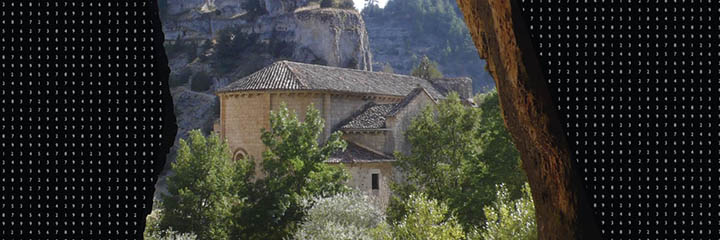
The book The Signature of God is the updated, complementary divulgative work expanding the discoveries presented in Pandora’s Verses. Both can be read independently. They are complementary, and together they deepen the understanding of the power of the Name of God.
Structural Index of “Pandora’s Verses”
This book was originally composed as 666 pages of content and structured according to the numerical matrix associated with the Name of God—more specifically, according to the use of the latent power within that Name, as narrated throughout the novel. The number 666 has often been associated with “the number of the beast” or the devil. Setting prejudice aside, this number speaks of two things: the power the human being can invoke, and the responsibility inherent to that power.
Kabbalah considers that the complete Name of God—and the invocation of its power—is hidden in the number 216. A great mystery protects the pronunciation of YHVH. Curiously, 6 × 6 × 6 = 216. Revelation 13:18 states: “Here is wisdom: let the one who has understanding calculate the number of the beast, for it is the number of a man. And his number is 666.” Or, in more everyday words:
Use your power well. Act responsibly. And do not become a beast.
The author’s deepest wish is that the reader enjoys Pandora’s Verses—and that it invites reflection.

VOLUME I – The Beginning
1. The Horizon Line
Years 1107 to 1110 – North Africa and Al-Andalus.
- Perspective
- Agreements and disagreements
- Too many words—and too few
- The right action
- Survival
- Effort
- Realization
- Samadhi
Illustration: Tareq
Historical notes: The Islamic world
Tao – Laozi (6th century BC)
2. The Meaning of the Path
Years 1109 to 1110 – Soria, Spain.
- As above, so below…
- Every cause has an effect
- All is mind
- Everything masculine has its feminine
- Everything vibrates; nothing is motionless
- Everything has two poles
- Everything flows and returns
Illustration: Rodrigo
Historical notes: Christian kingdoms of Hispania (1)
Yin Yang – Zoroaster (6th century BC)
3. The Knots of Chance
Year 1110 – Toledo, Spain.
- Dividing
- Adding
- Subtracting
- Multiplying
- Calculating
- Results
Illustration: Nur
Historical notes: Christian kingdoms of Hispania (2)
I Ching – Confucius (6th century BC)
4. The World’s Gaze
Years 1110 to 1111 – Sicily.
- Landscapes
- Delicacies
- Embraces
- Essences
- Symphony
Illustration: Alshira
Historical notes: The Vikings and the Mediterranean
Tetraktys – Pythagoras (6th century BC)
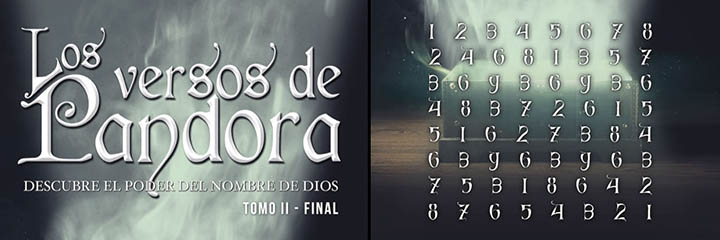
VOLUME II – The End
5. The Mirror of the Soul
Year 1111 – Monastery of Saint Catherine, Sinai.
- The horizon line
- The meaning of the path
- The knots of chance
- The world’s gaze
Illustration: Ulysses
Historical notes: The Catholic Church
Atman – Brahman (6th century BC)
6. The Presence of the Moment
Years 1112 to 1117 – Monastery of Saint Catherine, Sinai.
- Learning from the past
- Understanding the present
- Discovering the future
Illustration: Megiddo
Historical notes: Relevant events
Cosmos – Gautama (6th century BC)
7. The Name of God
Year 1117 – From Sinai to Jerusalem.
- In the beginning was the Word, and the Word was with God, and the Word was God.
- God told man in His fifth commandment: “Thou shalt not kill.” And man, in the name of God, killed.
Illustration: Kabbalah
Historical notes: The Jews and Kabbalah
Magic – An initiate (6th century BC)
8. The Threads of Destiny
Years 1117 to 1134 – Jerusalem.
- You shall love God above all things.
- You shall not take the name of God in vain.
- You shall keep the holy days.
- You shall honor your father and your mother.
- You shall not kill.
- You shall not commit impure acts.
- You shall not steal.
- You shall not bear false witness.
- You shall not consent to impure thoughts or desires.
- You shall not covet your neighbor’s goods.
Illustration: Pandora
Historical notes: The Holy Land
Karma – Buddha (6th century BC)
9. Pandora’s Verses
- Maya – Forests of Bodh Gaya, India.
- Nur – Elburz Mountains, Iran.
- Pandora – Maya
- Alshira – Remember, Soria.
- Pandora’s box – Pandora
- Tareq – Elburz Mountains, Iran.
- Hope – Pythagoras.
- Rodrigo – Río Lobos canyon, Soria.
- Pandora’s verses – Abracadabra.
Illustration: Maya
Final historical note: The mysterious Hermitage of San Bartolomé, at Río Lobos, Soria.
Pandora’s Verses
Discover the Power of the Name of God
Click to order this novel from Editorial Kolima, or on Amazon.
- If what you seek is to win, you may end up losing. Masters master arts, not competitions. Arts are not governed by rules and goals, but by poetry.
- The language of creation is not written with vocabulary. The words of Babel are many and communicate little, yet the feelings they convey are the same.
- The first word of creation is a sunrise; the next ones are conjugated every day, in every instant—written with ink-kisses and feathers of beauty.
- Places and moments form its grammar. Ancestors who love you secure its semantics. What you think, you become; what you feel, you attract.
- Beauty clothes love along its entire path—from the miracle of life to the mystery of death. To walk in beauty is to embrace its message.
- Sunrise and sunset paint the same image, dancing different rhythms in every heart. By listening to its music, we learn to sing.
- The choirs of souls resound into infinity. Whoever understands the melody dares to play a solo—one we all enjoy, and celebrate with joy.
- The artist’s expression is free and genuine, yet bound by the harmony of art itself. Numbers order everything—and allow everything.
- Creations within creation, infinities within infinities. To recite these verses, do not lose hope. Be impeccable. Then what you imagine, you will create.